
What is a China cymbal?

The first time you saw one, you may have wondered whether someone had mounted it wrong.
A typical cymbal slopes gently down from the cup in the middle toward the edge. A China starts out the same way, but just before the edge it changes direction and the outer rim flips up. These days, most Chinas have a rounded cup, much like a crash.
The sound, in a word, is trashy and full of impact. The overtones burst out the instant you hit it, and instead of the smooth bloom of a crash, you get a cutting edge that jumps right out at you. That is why some players simply call it a “trash cymbal.”
Then there is the way it is mounted. Chinas are often set up upside down, with the cup facing the floor. That turns the flipped edge downward, so you can strike the edge from the side with your stick, just as you would a crash.
That said, these features apply to many Chinas, not to all of them. Cup shapes vary, some models are meant to be mounted right side up, and a few are not even round. In the end, what makes a cymbal a China may be its sound more than its shape.
For the roles of crashes, rides, and other cymbals, see What are the types of cymbals?
Upside down is not the “correct” way to mount a China. Some players mount it right side up and play the flipped edge. Even drummers disagree about which side is the top.
Its roots: the Chinese bó
As the name suggests, its roots are in China.
Metal percussion has been part of Chinese ritual, military, and religious music for a very long time. The best-known example is the bó (鈸). It is used in pairs: you hold each one by its squared-off cup as if it were a handle and clash them together face to face. It is still heard in traditional stage music such as Peking opera. Some traditional Chinese-style Chinas still have a squared-off cup today, most likely a remnant of that shape made for holding.
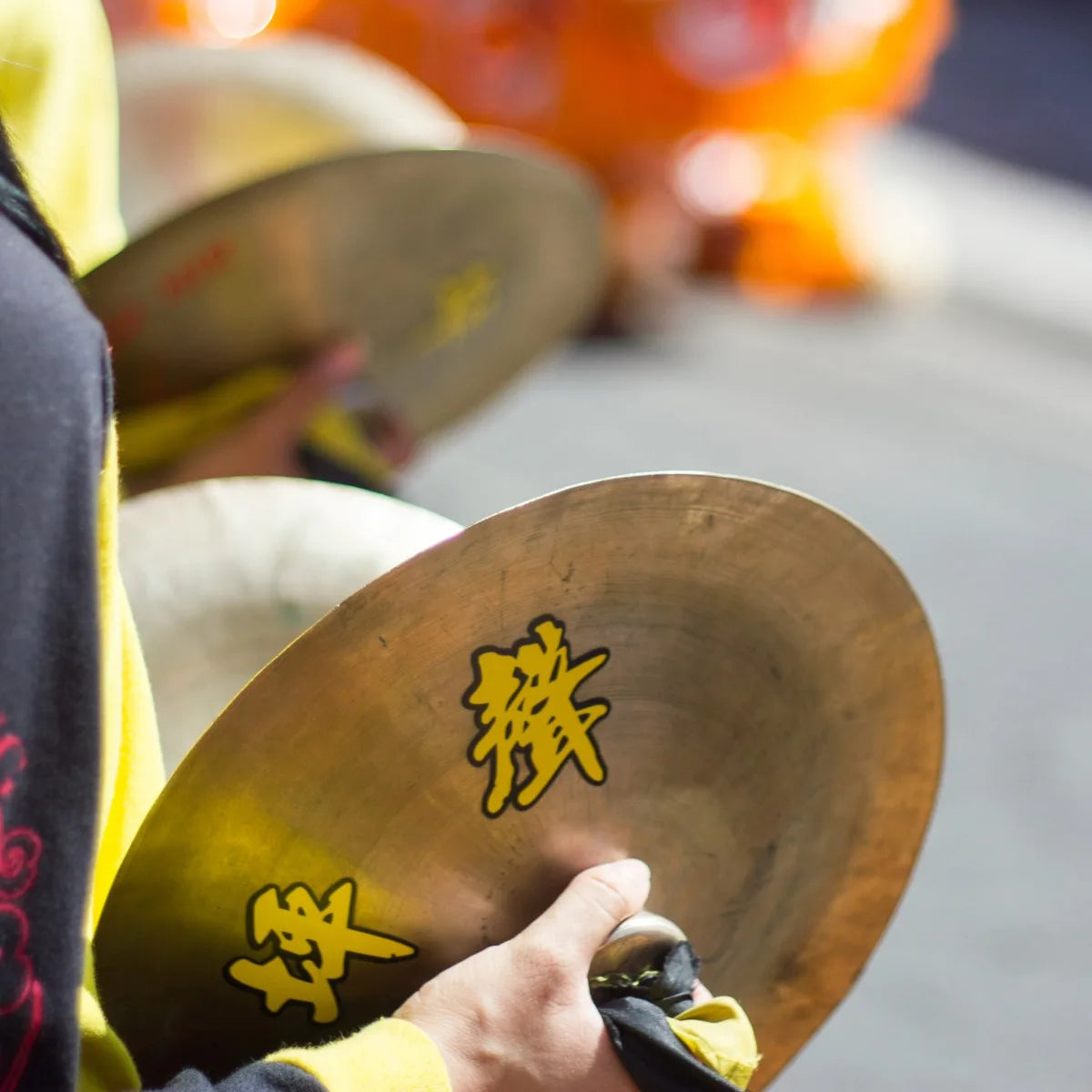
The name comes from Westerners calling cymbals of this shape “China” cymbals. China has many relatives of the bó, each with its own shape and sound, but in Western music they are all grouped together as “China-type” cymbals.
One more thing worth knowing is the difference in lineage. Most cymbals on today’s drum kits descend from the Turkish tradition, with a rich, blooming sound. The China comes from a different line, prized for a cutting, trashy voice. You could say the China is treated as an “effects cymbal” because its different origins come straight through in the sound. For the story of the cymbal itself, see The history and evolution of the cymbal.
On the drum kit for over 100 years
Say “China cymbal,” and most people think of rock or metal. But the China’s history with the drum kit goes back surprisingly far.
The setting is America in the 1910s, when ragtime was popular, just before the birth of jazz. The cymbals you hear on recordings from that era do not sound like modern cymbals; they have the sharp, piercing sound of a bó. Photos of drum kits from the time often show a Chinese cymbal mounted upside down on top of the bass drum. In other words, the upside-down China was already around more than a century ago.
Why Chinese cymbals? No one knows for certain. Turkish cymbals were still hard to find in America; durability and price may have played a part; and that sound suited the lively, slightly rowdy music of the day. Most likely it was a combination of reasons.
In the 1920s, Turkish-style cymbals took over the leading role, and the China became an “effect” used to add an exotic flavor to a tune. Yet by the mid-1920s, some drummers were setting up both and switching between them, an early form of today’s setups with several cymbals of different colors.
The next turning point was war. In the 1940s and ’50s, imports from China were cut off, and Western cymbal makers began producing their own China types.
Then came the 1970s. Fusion drummer Billy Cobham is credited with boldly playing an upside-down China, and the approach spread quickly. From there, the China became an essential cymbal in rock, heavy metal, and progressive rock.
When do you play it?
There is no single right way to use a China. Here are some of the most common:
- As a one-shot accent (on hits or at the end of a fill)
- Riding on it to keep time
- Playing it with brushes or mallets
- Stacking it on another cymbal
Where you put it and how you play it is up to you.
Not all Chinas are the same
The word “China” covers a lot of ground in both shape and sound. Let’s look at the variety, using the VEQUS Brilliant series as an example.
Broadly, there are three kinds: “regular” Chinas with no holes, vented Chinas with holes, and small-diameter Chinas.


| Name | Features | Sizes |
|---|---|---|
| CHINA | No holes | 16", 18", 20" |
| VENT CHINA | Large holes: a 6-hole version, and a 12-hole version that combines large and small holes | 16", 18", 20" (both 6- and 12-hole) |
| REVO CHINA | Many small holes | 16", 18", 20" |
| VENT CHINA (MINI) | Small-diameter, 6 holes | 10", 12" |
It is quicker to hear it than to read about it. Here are the Brilliant series Chinas played side by side.
What do the holes change?
The first time you see a cymbal with holes in it, you might wonder why anyone would do that. The holes are there on purpose.
Holes reduce the amount of vibrating metal. As a result, you will generally hear changes like these:
- Faster response: the sound speaks the instant you hit it
- Shorter sustain: the note dies away quickly for a crisper, tighter sound
- Air escapes more easily when stacked: less air gets trapped between it and the cymbal underneath
That is why vented cymbals are a popular choice when you want short, sharp accents or plan to stack.
Whether holes raise or lower the pitch, however, cannot be said in general. It depends on the number, size, and layout of the holes. A few large holes and many small ones are very different approaches, even if both count as “vented.”
Here are 18-inch Brilliant series Chinas with no holes, VENT CHINA (12-hole), and REVO CHINA. Because the size and series are the same, you can hear the effect of the holes on its own.
How does size change the sound?
There is a fairly clear trend between cymbal size and sound. Bigger cymbals are louder, lower in pitch, and sustain longer. Smaller ones respond faster, sound higher, and die away quickly. The same goes for Chinas.
The most common sizes are 16 and 18 inches. At 20 inches and up, there is a lot more wash, and some can even be ridden like a ride. At the other end, Chinas of 12 inches and under are sometimes called “China splashes” and are often used for short, cutting accents or in stacks.
| Size | Sound | Typical use |
|---|---|---|
| 10"–12" | High, short, cutting | Quick accents, stacks |
| 16" | Fast response, moderate volume | Mainly accents |
| 18" | A good balance of response and volume | Accents and riding |
| 20" | Loud, low, long sustain | Riding, loud passages |
Keep in mind that this is only a rough guide. Size is not the only factor; thickness matters too. At the same size, a thicker cymbal tends to sound higher. Weight and finish also change the impression quite a bit.
Here are the 16- and 18-inch Brilliant series Chinas, plus the small VENT CHINA (MINI). Hearing different sizes from the same series makes the differences easy to pick out.
Wrapping up
The China may be the cymbal that divides opinion most sharply. It is trashy and full of impact, and that very character is why it has stayed on the drum kit for more than a hundred years.
Accent, ride, or stack: depending on how you use it, the same cymbal can show a completely different face. Thinking about where it goes in your setup is a good place to start.